There are moments in life that divide everything into “before” and “after.”
For Patrick, that moment came the day of the fire.
He wasn’t a bystander. He wasn’t frozen by fear. When he saw a woman trapped inside a burning building, he ran toward the flames. He tried to pull her to safety, to give her a chance at life when every second was filled with smoke, heat, and chaos.
But fire is merciless. It doesn’t care about courage or intention. In the seconds that followed, Patrick’s body was engulfed. He suffered catastrophic burns. His sacrifice saved a life—but it left him forever changed.
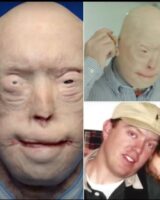
In the months that followed, Patrick endured pain most of us cannot imagine. His body healed, but his face—the part of us most visible, most tied to our sense of identity—was destroyed. Scars ran deep, reshaping him into someone he no longer recognized.
For years, he lived in hiding.
When he left his home, it was with a cap pulled low, sunglasses shielding his eyes, prosthetic ears fixed carefully in place. He walked quickly, avoiding attention, avoiding the gaze of strangers that lingered too long. He dreaded the looks, the whispers, the questions.
He wasn’t ashamed of his courage. But he was ashamed of the reminder his face had become.
Every mirror was a confrontation. Every photograph a punishment. Every day a test of will.
And yet, through all of it, Patrick remained alive. And being alive meant that hope—fragile though it was—could still flicker.
That flicker grew into something more when doctors began to speak of a possibility.
It was a word that sounded like science fiction: transplant.
Not just skin grafts, not just reconstructive surgery. A full face transplant.
One of the most ambitious, difficult, and risky procedures modern medicine had ever attempted.
For years, Patrick had heard “no.”
Now, for the first time, there was a “maybe.”
He knew the risks. Months of preparation. Dozens of specialists. Countless tests. The possibility of rejection. A lifetime of medication to suppress his immune system. The haunting truth that his body might reject the face entirely.
But he also knew the alternative: to live the rest of his life hidden, afraid to be seen, carrying the reminder of the fire on the outside as well as the inside.
Patrick chose courage again.
The day of the surgery arrived. The operating room filled with surgeons, nurses, anesthesiologists—a team of nearly 100 people. The procedure would last more than 24 hours. Every detail had to be perfect: arteries connected, nerves rewired, muscles fused. A single mistake could cost Patrick his life.
As he lay unconscious, the team worked.
They removed the destroyed tissue and began the painstaking process of attaching a donor’s face. The donor family had given a gift beyond measure, the ultimate act of compassion. Their loss had become Patrick’s chance at a new life.
When it was over, Patrick lay silent in the hospital bed, his new face swollen and bandaged. Days passed. Then weeks. Slowly, the swelling eased. Slowly, the mirror revealed something different—not the face he had before the fire, not the face of the donor, but something new. Something that belonged to Patrick again.
The first time he saw his reflection, tears filled his eyes.
“I finally look human again,” he whispered.
The world met his transformation with astonishment.
News outlets carried his story. Photos circulated. The before-and-after images shocked millions. People who had never known him now knew his name.
But for Patrick, it wasn’t about fame.
It was about walking into a store without feeling eyes burn into him.
It was about seeing children look at him without fear.
It was about the simple gift of smiling in a photograph, of showing his face to the world without shame.
Recovery was long. Therapy became part of his daily life—learning to move new muscles, to blink, to chew, to speak clearly again. Every twitch of a lip, every blink of an eye was both a victory and a miracle.
There were setbacks. Rejection scares. Long nights of pain. The constant awareness that his body might one day turn against this new face.
And yet, Patrick pressed on. Because he understood better than anyone that life is fragile, and every moment of acceptance, every second of connection, is worth the struggle.
He began to speak publicly, sharing his story not as a tale of tragedy, but as a testament to resilience. He wanted people to understand that scars—whether visible or hidden—do not diminish humanity. That heroism sometimes means running into a fire, but sometimes it means facing the world when you want to disappear.
Patrick became an emblem of what science, medicine, and compassion can achieve together. But more than that, he became a symbol of hope for anyone who has ever felt broken beyond repair.
When people see him now, they don’t just see the damage, or even the miracle of the transplant. They see a man who refused to let tragedy have the final word.
Patrick once said, “I don’t want people to remember me for what happened to me. I want them to remember that I kept going.”
And that is his legacy: not just the face he lost, not just the face he gained, but the courage to live fully in the space between.
Because true strength isn’t found in avoiding pain.
It’s found in walking through it, scarred but unbroken, choosing every day to show up in the world as you are.
Patrick’s story reminds us that sometimes, miracles are not about erasing the past.
Sometimes, they are about giving someone the chance to write the future.
