The African sun blazed over the sweeping plains of Kenya, where herds of elephants moved with ancient grace across the land. To the casual eye, the sight was timeless—majestic animals, strong yet gentle, bound together in the rhythm of survival. But within one herd, a silent struggle unfolded.
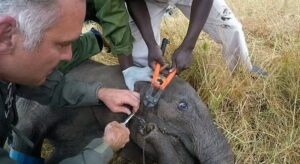
Among the elephants was a female, her movements heavy and uneven. Lodged deep in her side was an arrow, crudely made and barbed, driven there by farmers desperate to protect their crops. To them, elephants were intruders, great gray shadows that trampled fields and destroyed livelihoods. But to the wounded elephant, the arrow meant something different—pain beyond endurance, infection creeping through her body, and the slow terror of being left behind by her herd.
Word of her condition spread quickly. The Mara Elephant Project, a team devoted to protecting these giants, knew they had little time. A wound like this could kill. But to save her meant more than medical skill—it meant courage, teamwork, and respect for the instincts of one of the most powerful animals on Earth.
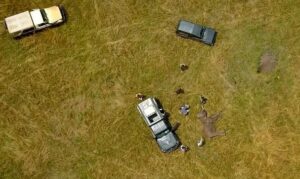
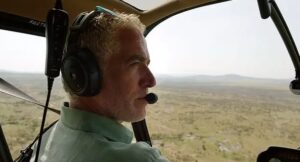
That morning, a rescue team gathered. Veterinarians, rangers, and one unexpected companion—wildlife cameraman Gordon Buchanan—boarded a helicopter. His purpose was to film, but what he witnessed would become something far greater than a documentary. It would be etched into his heart.
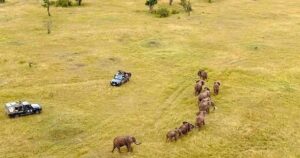
From above, Gordon watched the herd. The elephants moved like an unbroken chain, their huge bodies glistening in the sun, their steps purposeful. Separating the injured female would not be easy. Elephants are fiercely protective, and when one is in danger, the rest rally in defense.
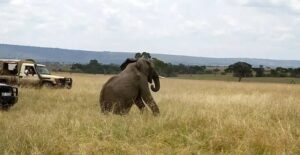
The helicopter descended, its blades roaring, whipping the tall grass flat. The herd scattered, but not without resistance. One elephant refused to leave the wounded female’s side. This loyal companion nudged her gently, guarded her fiercely, and when the humans drew near, trumpeted in defiance as if declaring, “You will not take her from us.”
On the ground, the vets prepared their tranquilizer rifle. A sharp crack, a dart in flight, and the massive creature staggered before collapsing with a thundering crash that shook the earth. Dust swirled around her fallen body. The guardian elephant charged, circling her, challenging the intruders. The team could not harm it—they could only use shouts, claps, and the helicopter’s force to push it back. At last, reluctantly, the companion retreated, eyes never leaving its fallen friend.
Silence fell.
Dr. Limo, the lead veterinarian, stepped forward. The arrow had cut deep, tearing tissue with every movement. His hands worked quickly but carefully. Time was precious—every moment under anesthesia was a risk. Rangers poured water over her thick gray skin to keep her cool beneath the relentless sun. Gordon filmed, but in truth, he barely noticed the camera in his hands. He was watching life hang in the balance.
Finally, with a decisive pull, the arrow came free. The wound was flushed with antiseptic, antibiotics injected deep into her muscle, and healing compounds smeared across the torn flesh. With the antidote administered, the team stepped back, holding their breath.
For long seconds, nothing. Then her chest heaved. A deep rumble rose from within her. Slowly, with immense effort, she pushed against the earth, rising onto her feet. Dust clung to her skin, blood streaked her side, but she was alive—standing tall once more.
From the distance came a trumpet, low and urgent. Her herd was calling. With deliberate steps, she moved toward them. In a rush of sound and movement, her loyal guardian met her, circling her in relief. Together, they vanished into the savanna, their shadows stretching across the horizon as the sun dipped lower in the sky.
The entire rescue had taken just 45 minutes. Yet in that sliver of time, a life had been saved, a family restored. Gordon later reflected, “Before the Mara Elephant Project had a helicopter, they found 120 elephant carcasses. Now, lives are being saved. Space for elephants is shrinking. Without action, without compassion, we will lose them.”
But the day was not over. Another urgent call: a calf had been found with its trunk caught in a snare. Once again, the team mobilized.
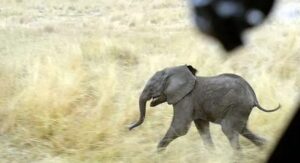
They found the young elephant stumbling in panic, its tiny trunk bound cruelly by a wire loop. Such snares, set for smaller animals, often claim elephants by accident—sometimes fatally. The mother stood nearby, torn between fear of the humans and desperation for her baby.
The vets worked fast. They restrained the calf, cut away the wire, and treated the bleeding wound. Freed at last, the calf bolted back to its mother. She embraced it with her trunk, pulling it close in a fierce, trembling hug. The air filled with a sound both mournful and joyous—the deep rumble of reunion.
By nightfall, two elephants had been saved. Two futures reclaimed. For Gordon, watching through his lens, it was a reminder of what conservation truly meant. It was not just science or strategy—it was love, loyalty, and the unspoken bond between creatures who share this earth.
As darkness spread across the plains, the herds moved on, scarred but still whole. A female elephant walked with her companion by her side, a calf nestled against its mother, both carrying wounds that would one day heal.
The rescues were victories. But more than that, they were reminders—of compassion, of urgency, of the extraordinary resilience of these gentle giants.
And beneath the endless Kenyan sky, hope still walked—on four massive, steady feet.
