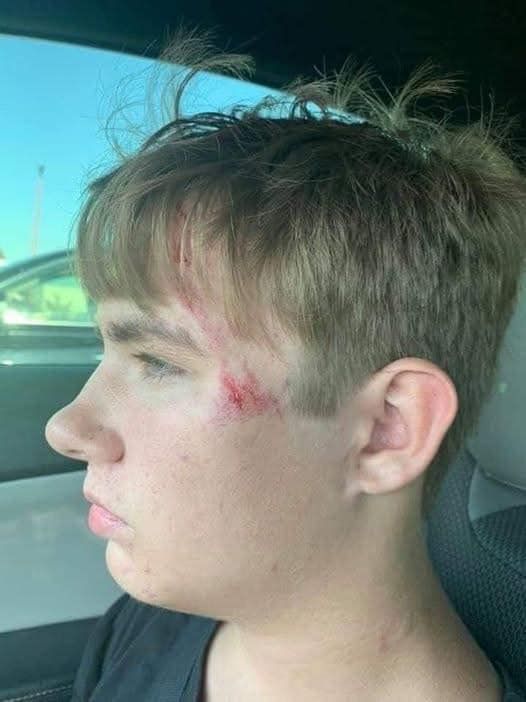
It was supposed to be just another lazy summer afternoon.
Seventeen-year-old Tanner had joined his mom and younger siblings for a casual outing at Scissortail Park — the kind of sunny, wide-open space perfect for picnics, laughter, and cooling off near the water. People strolled along the walkways. Kids ran through the splash pads. Birds skimmed over the surface of the pond. It was peaceful, ordinary — until it wasn’t.
Tanner was walking alongside his mom when he suddenly stopped.
She remembers him doing a quick double take toward the water. In that instant, something shifted in him. He didn’t say a word. He just dropped whatever he was holding and ran — full speed — toward the pond.
At first, his mother was confused. She called after him, unsure what had triggered such urgency. Then she saw it too: a small figure, thrashing just beneath the water’s surface.
A toddler.
No older than two, barely visible among the reeds, slipping under fast.
Without hesitation, Tanner dove in.

There was no time to think, no time to call for help. His instincts had taken over, fueled by something deeper than training — a raw, human drive to protect.
The water was deeper than it looked. Murkier. He fought through it, reached the child, and pulled him up. But in the process, Tanner hit his head against a submerged rock or ledge. Blood began to mix with the water. Still, he didn’t stop.
By the time emergency responders arrived — police, firefighters, medics — Tanner had already gotten the child to safety. The little boy was coughing, gasping, crying — alive.
The boy’s mother collapsed in tears. She couldn’t stop sobbing, couldn’t find words strong enough to express her gratitude. One moment, her world had tilted toward unthinkable loss. The next, it had been pulled back from the edge — by a teenager who didn’t even hesitate.
Tanner was taken to the hospital, where he received staples for the head injury. He didn’t complain. Didn’t brag. If anything, he seemed surprised by all the attention.
In his mind, he had simply done what anyone would do.
But not everyone would have done it. Not everyone would have noticed the flailing arms. Not everyone would have connected the dots in a single heartbeat, raced toward the water, and thrown themselves into danger without a second thought.
Tanner did.
Because behind his quiet nature is a heart that moves faster than fear.

He’s not a lifeguard. He’s not a first responder. He’s a 17-year-old kid — one who likes video games, skateboarding, and goofing off with his siblings. But in that one critical moment, he was exactly the hero someone’s child desperately needed.
And now, a family is whole. A little boy will get to grow up. All because one teenager chose not to freeze, not to film, not to look away — but to act.
In a world too often dominated by headlines that break our hearts, Tanner reminds us what courage really looks like: unplanned, unpolished, and unbelievably powerful.
So let’s share this story — not just because it feels good, but because it’s real. Because sometimes the heroes among us wear sneakers, carry their little siblings’ snacks, and quietly go back to their lives without realizing they just rewrote someone else’s future.
Thank you, Tanner.
The world is better because you’re in it.
